Object histories · Michigan-made history · November 22, 2026
When the drawer says Grand Rapids
A Grand Rapids label is a city story, not a single factory. And a Stickley Brothers mark from Michigan is not Gustav Stickley’s New York shop.
You pull out a drawer at Midland, or in a barn at Davisburg, or under the roof at Kalamazoo, and there it is: a paper label, a stencil, or just the words “Grand Rapids.” A lot of people stop at the name and figure they already know the rest. The useful part is learning how to read what you found.
Grand Rapids called itself the Furniture City. That was not a claim about hand-crafted luxury. It was a machine-made, middle-market industry — furniture for the houses that actually got furnished.
The traditional first maker is William “Deacon” Haldane, a cabinet-maker from upstate New York. William J. Etten’s 1926 city history says he arrived in 1836 and was at work the next year in a dwelling at Pearl and Ottawa. Power machinery comes later, and the sources do not agree on a single “first factory” date. Etten has Haldane installing a circular saw and lathe in 1848. Christian G. Carron’s later history of the industry names Ebenezer Ball as the first to use power machinery, about 1849.
The city’s name was the brand
Between 1899 and 1913, most furniture made in Grand Rapids was labeled not with the factory’s name but with a communal “Grand Rapids Made” logo — a city-wide mark meant to sell the place, not one firm. The words were valuable enough to fake. Etten writes that “Made in Grand Rapids” was made to mean a piece was the best, and that dealers who advertised “Grand Rapids Furniture” but sold a cheap grade made elsewhere were enjoined by court actions.
Do not expect a flashy logo on every piece. Many marks in reference books were taken from catalogues and advertisements, and they seldom appear on the furniture itself. Still look: in the drawers, on the back, and under the top.
The city also ran a semi-annual wholesale Furniture Market, beginning in the late 1870s — Etten dates the first market to 1878. It peaked in the 1910s and 1920s. In 1925 it filled ten exhibition halls with about 560 dealers. The Market ceased in 1965. That 560 is a 1925 trade-market number, not a count of anyone you will meet on the grounds.
A few names you may actually meet
If the label does name a factory, these are three you are likely to see.
Berkey & Gay started as Berkey & Matter in November 1862, became Berkey Bros. & Gay in 1866 after George W. Gay bought in, and was incorporated as the Berkey & Gay Furniture Company in August 1873.
The Widdicombs came from Devonshire, by way of New Hampshire, around 1856 or 1857. Etten dates George Widdicomb’s arrival to 1856; Carron says about 1857. The business was incorporated in 1873 as the Widdicomb Furniture Company.
Stickley Brothers Company was organized in Grand Rapids in 1891 by Albert Stickley, with a factory on Godfrey Avenue. The Metropolitan Museum dates the firm 1891–1954 and locates the work in Grand Rapids. A 1904 inlaid oak desk in the Met’s collection was made for the Louisiana Purchase Exposition in St. Louis, where the firm won a Grand Prize. They sold their Arts & Crafts furniture as “Quaint Furniture.”
This is not Gustav Stickley
The shared last name is the confusion people walk into. Gustav Stickley was born in Osceola, Wisconsin, in 1858, and died in Syracuse, New York, in 1942. He founded the Craftsman Workshops in 1899 — called United Crafts before 1904 — in Eastwood, in Syracuse. His furniture is New York–made. Stickley Brothers of Grand Rapids is a Michigan factory with a different first name on the door. If the drawer says Grand Rapids, you are not holding a Craftsman Workshops piece from Eastwood.
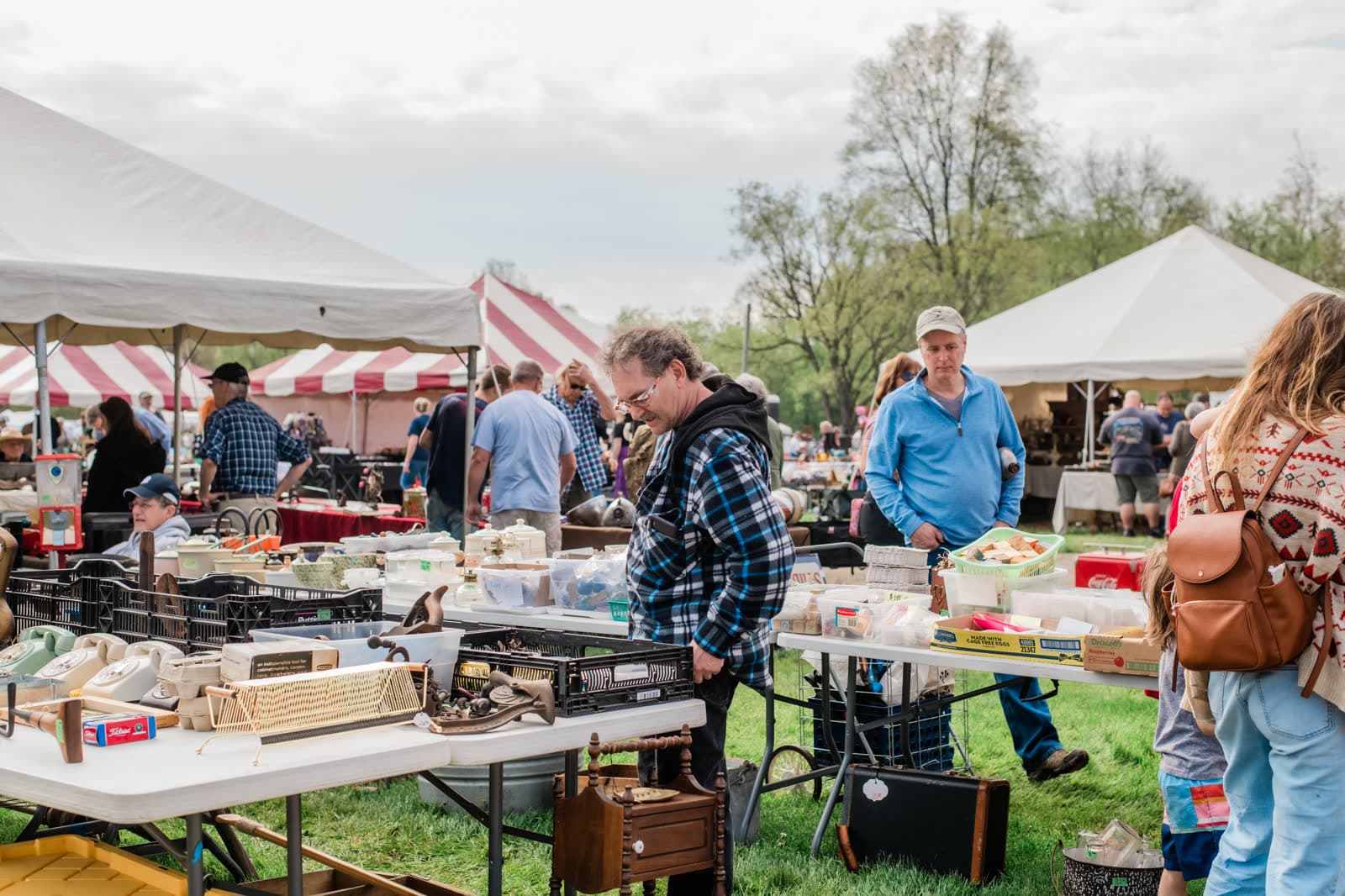
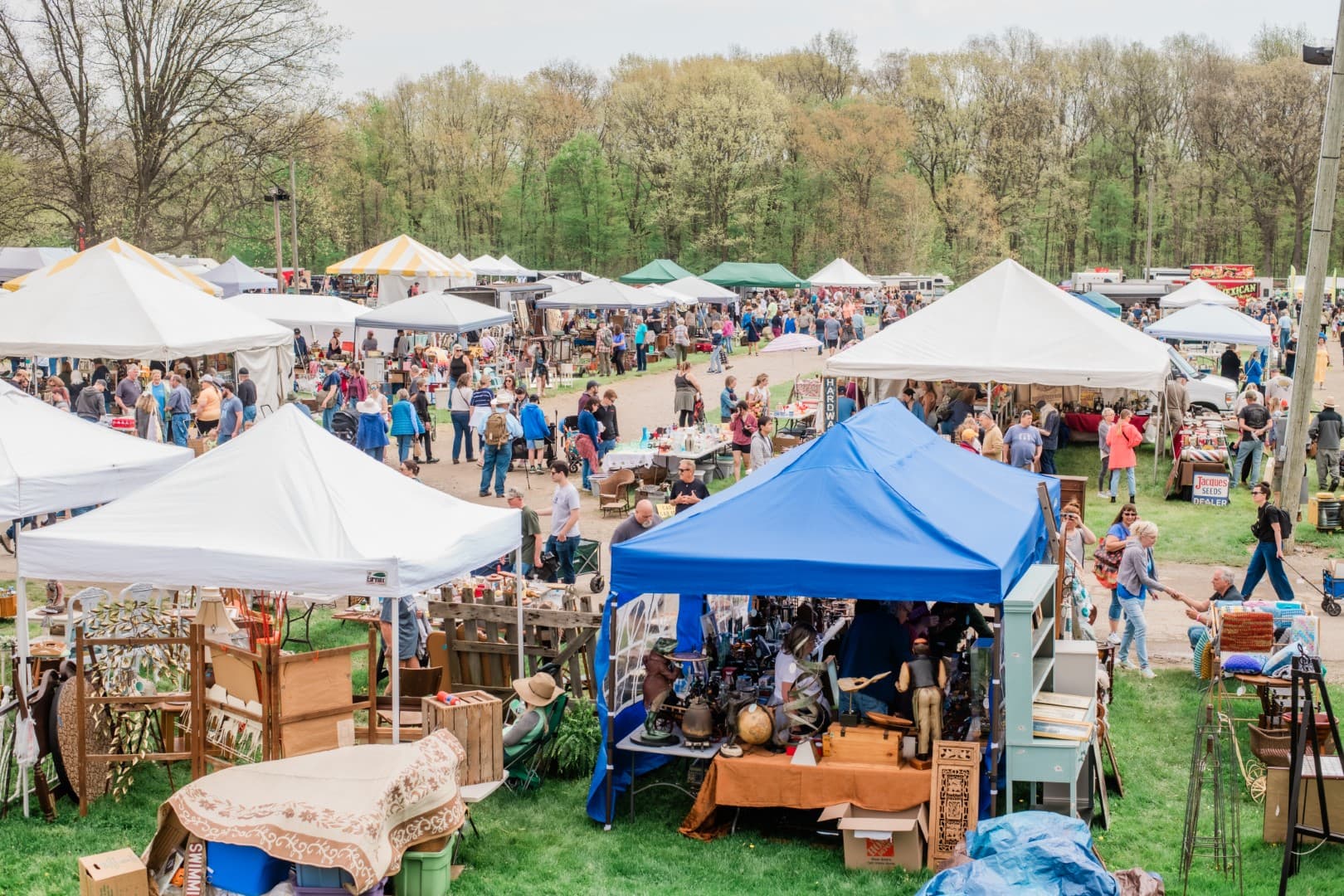
You will still find the labels in the furniture rows. Midland and Davisburg are the big outdoor and barn hunts, with over 500 dealers and enough dressers to make opening drawers a habit. Kalamazoo puts the same hunt under one roof, with hundreds of dealers at the Expo Center. Take a minute with the ones that name the city. The mark is trying to tell you where it was made. It is not trying to tell you it was made by Gustav.
Sources
- Chipstone review of Christian G. Carron, *Grand Rapids Furniture: The Story of America’s Furniture City* (Public Museum of Grand Rapids, 1998)
- William J. Etten, “The Furniture Capital of America” (1926)
- Metropolitan Museum, Stickley Brothers inlaid oak desk (1904)
- Metropolitan Museum, *Quaint Furniture* catalogue (January 1906)
- Metropolitan Museum, Gustav Stickley sideboard table, Eastwood, New York (ca. 1901)
More from this desk